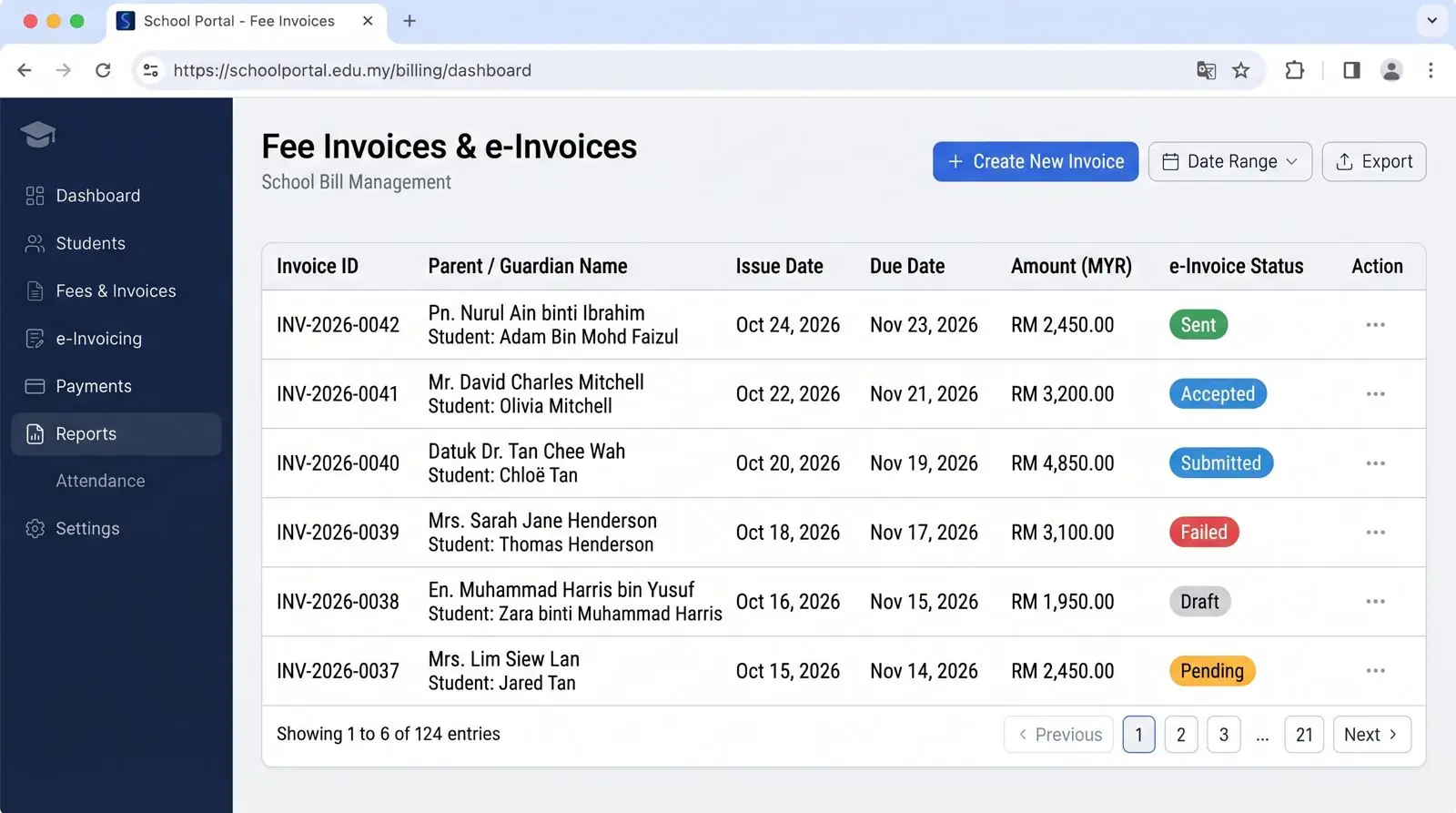
From 1 September 2026, a private school with annual revenue of RM3 million or more must issue LHDN e Invoices through MyInvois. Below RM3 million, e Invoice is voluntary. For many private, international and Chinese independent schools with 400 or more students, that line is closer than it looks.
This guide is for bursars, finance heads and principals. It covers who is in scope, what changes in fee billing, the RM10,000 rule that catches annual fees, which parent details to collect, and a checklist to work through this term.
Is your school in scope?
The exemption threshold was RM500,000 until the end of 2025, RM1 million from the start of 2026, and RM3 million from 1 September 2026. A school at or above RM3 million in annual revenue must issue e Invoices. A quick way to check is students multiplied by average annual fees:
| Students | Average fees a year | Annual fee revenue | Position |
|---|---|---|---|
| 300 | RM8,000 | RM2.4 million | Below the threshold |
| 400 | RM7,500 | RM3.0 million | At the threshold |
| 1,000 | RM6,000 | RM6.0 million | Above |
| 600 | RM12,000 | RM7.2 million | Above |
Two points are often missed. First, the exemption does not apply if a holding company, related company or joint venture has revenue of RM3 million or more, so count the whole school group, not one campus. Second, schools run by non profit boards or associations may be treated differently, so confirm the school's position with a tax adviser before deciding.
The timeline so far
e Invoice has been rolled out in phases by business size since 2024:
| Phase | Annual revenue | Required from |
|---|---|---|
| 1 | Above RM100 million | 1 August 2024 |
| 2 | RM25 million to RM100 million | 1 January 2025 |
| 3 | RM5 million to RM25 million | 1 July 2025 |
| 4 | Up to RM5 million, if not exempt | 1 January 2026, with a relaxation period to 31 December 2027 |
Most schools fall in Phase 4. The relaxation period gives the office time to settle in, but it is not a reason to wait: systems, parent records and routines take a term to get right.
What changes in fee billing
Each fee document is sent to LHDN MyInvois, checked and validated. The validated e Invoice carries a unique reference and a QR code, and that is what the parent receives. In practice it covers three documents:
- Fee invoices for tuition, registration and other school fees
- Receipts for fee payments received
- Credit notes for discounts, sibling rebates and fee adjustments
The bursar's daily routine should not change much. The difference is that the fee system now has to send each document to MyInvois and keep the validated record, instead of only printing or emailing it.
The RM10,000 rule
This is the rule most likely to affect schools. From 1 January 2026, any single transaction above RM10,000 needs its own e Invoice with the buyer's details. It cannot be folded into a consolidated e Invoice.
Annual fees paid in one go, boarding fees and international school fees often cross RM10,000 per student. For those, the school needs the parent's details on the e Invoice. Some guides say smaller Phase 4 businesses have more room during the relaxation period, so check the current position with a tax adviser.
Consolidated e Invoices for parents
For transactions that do not need their own e Invoice, such as smaller monthly fees where the parent has not asked for one, a school can issue one consolidated e Invoice covering the month. It must be submitted to MyInvois within 7 days after the end of that month. A parent who asks for an individual e Invoice should get one.
Which parent details to collect
LHDN eased the identification rules for individual buyers in September 2026. For parents who need an individual e Invoice:
- Malaysian parents: their tax identification number (TIN), their MyKad number, or both
- Foreign parents with MyPR or MyKAS: the same options
- Other foreign parents: passport number, with their LHDN TIN if they have one
- For everyone: full name, address and phone number
The easiest time to collect these is at enrolment or re enrolment. Add them to the parent record once, and every invoice after that picks them up automatically.
What to tell parents
Most parents will not notice much: invoices still arrive the usual way, now with an LHDN reference and QR code. Send a short note before the first e Invoice goes out, explaining the change and asking parents to check their details on file.
Some parents will want an individual e Invoice, for example when an employer pays the fees or when they keep records for their own business. Make that request simple, such as a reply to the bursar's office, and record their details once.
What the school system should do
A school management system that is ready for e Invoice should create fee invoices, receipts and credit notes from the fee schedule, submit them to MyInvois without a separate tool, keep each validation record, and store parent details for invoices above RM10,000.
In the school system offered here, fee invoices, receipts and credit notes are submitted to LHDN MyInvois through a connection already built in, and e Invoice is included in the package. Canteen sales and e wallet top ups sit outside the e Invoice module. See how LHDN e Invoice works for schools.
Rules as published by LHDN up to November 2026, including the e Invoice guideline update of 7 September 2026. They change often. This guide is general information, not tax advice.